Monday, May 6, 2019

Sha'arit Yisra'el

http://yisreh1.byethost7.com/kalender.html?i=1

Untuk segala sesuatu ada masanya, untuk apapun di bawah langit ada waktunya.
(Pengkhotbah 3 : 1)


Hebrew Calendar

Kalender Ibrani (הלוח העברי / ha'luach ha'ivri)

  Powered by Google TranslateTranslate

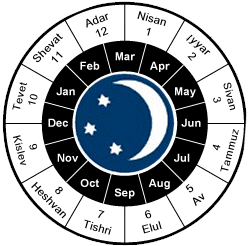
Nama bulan kalender Ibrani dalam satu tahun 

Nama IbraniNama IndonesiaUrutanDurasiPersamaan Dalam Masehi
נִיסָןNisan130 hariMaret - April
אִיָּרIyar229 hariApril - Mei
סִיוָןSivan330 hariMei - Juni
תַּמּוּזTammuz429 hariJuni - Juli
אָבAv530 hariJuli - Agustus
אֱלוּלElul629 hariAgustus - September
תִּשׁרִיTishri730 hariSeptember - Oktober
חֶשְׁוָןCheshvan829 / 30 hariOktober - November
כִּסְלֵוKislev930 / 29 hariNovember - Desember
טֵבֵתTevet1029 hariDesember - Januari
שְׁבָטShevat1130 hariJanuari - Februari
אֲדָר אAdar I (Muncul pada tahun kabisat saja)1230 hariFebruari - Maret
אֲדָר בAdar II
(Disebut Adar Beit / Adar Sheni pada tahun kabisat)
12
(13 pada tahun kabisat)
29 hariFebruari - Maret

Bulan Ibrani

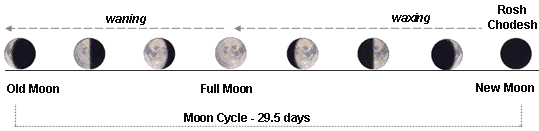
Durasi bulan Ibrani (חודש / Chodesh) diukur berdasarkan jumlah waktu yang diperlukan bulan untuk melakukan suatu putaran, yaitu sekitar 29,5 hari :
Kondisi bulan pada saat akhir bulan (tanggal tua) <=<= Kondisi bulan berwana hitam menandakan awal bulan (tanggal muda)
  • Rosh Chodesh
    Penampakan bulan baru disebut Rosh Chodesh (ראש חודש / "Kepala Bulan"). 12 חודשים / Chodeshim (bulan) = 1 שנה / Shana (tahun)
  • Tahun Kabisat Bulan
    Seperti yang kita tahu bahwa 1 tahun tata surya = 365 hari tetapi 1 tahun bulan hanya 354 hari (29,5 x 12), sehingga bulan extra ditambahkan ke dalam kalender Ibrani tiap 2 atau 3 tahun. Rumus pastinya hanya diketahui oleh beberapa orang tertentu saja, yang jelas tiap 19 tahun ada 7 tahun kabisat (tahun ke-3, ke-6, ke-8, ke-11, ke-14, ke-17, dan ke-19). Pada tahun kabisat bulan ke-13 disebut אדר שני / Adar Sheni (Adar II)

    Pada kitab Taurat, bulan pertama kalender Ibrani adalah Nisan (ketika terjadi Paskah - lihat Keluaran 12 : 1 - 12); bagaimanapun, ראש השנה / Rosh Hashanah ("tahun baru") terjadi di bulan Tishri yaitu bulan ke-7, dan di bulan ke-7 itulah jumlah tahun bertambah.

Nama-nama hari selama 1 minggu dalam kalender Ibrani 

Nama IbraniTransliterasiNama Indonesia
יום ראשוןYom RishonHari Pertama (Minggu)
יום שניYom SheniHari Kedua (Senin)
יום שלישיYom ShlishiHari Ketiga (Selasa)
יום רביעיYom Revi’iHari Keempat (Rabu)
יום חמישיYom ChamishiHari Kelima (Kamis)
יום שישיYom ShishiHari Keenam (Jumat)
יום שבתYom ShabatHari Ketujuh (Sabtu)

Hari Ibrani

Hari Ibrani (יום / Yom) dimulai pada saat matahari terbenam (para rabi berpendapat bahwa hari dimulai pada saat matahari terbenam berdasarkan gambaran aktifitas Tuhan dalam penciptaan, "Jadilah petang dan jadilah pagi, itulah hari pertama.Kejadian 1 : 5). Petang kadang didefinisikan "setelah sore", kalau di Indonesia matahari terbenam sekitar jam 6 pm.
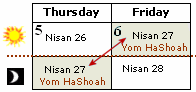
Semenjak hari Ibrani (יום / Yom) dimulai pada saat matahari terbenam, anda harus mengingat bahwa hari raya Yahudi sebenarnya dimulai pada malam sebelum hari-H. Sebagai contoh יום השואה / Yom HaShoah (Peringatan Holocaust) terjadi pada tanggal 27 Nisan, yang sebenarnya sudah dimulai setelah matahari terbenam pada hari kemarin :
Sebagai contoh Yom HaShoah dirayakan pada hari kamis tanggal 5 (setelah matahari terbenam) dan hari jumat tanggal 6 (selama siang hari). Sehingga inilah yang menyebabkan hari raya Yahudi merentang hingga dua hari pada kalender masehi kita.

Contoh perhitungan hari Ibrani pada kronologi kematian, penguburan, dan kebangkitan Yesus (Yohanes 19 : 31 - 37)

Untuk memahami kronologi ini, anda harus ingat bahwa hari Ibrani dimulai pada saat matahari terbenam dan berakhir pada sore di hari berikutnya. Jika Yesus disalibkan pada bulan Nisan tanggal 14 (siang hari) dan kemudian dibangkitkan setelah 3 hari & 3 malam, maka kita bisa menyimpulkannya seperti ini :
Hari ke-Tanggal pada bulan NisanNama masehiKondisi hariPeristiwa
514 (Imamat 23 : 5)RabuMalamPerjamuan Paskah terakhir Yesus (Matius 26 : 17 - 25);
Yesus ditangkap.
KamisSiangDomba Paskah dikorbankan;
Yesus disalibkan; dikuburkan. (Yohanes 19 : 31 - 32)
1/2 Hari
615 (Imamat 23 : 6)KamisMalamHari ke-1 roti tak beragi;
Shabat setelah Paskah (Shabat pada hari pertama hari raya roti tak beragi / Imamat 23 : 6 - 7).
1 Hari
JumatSiangShabat setelah Paskah (berlanjut);
Kubur Yesus dijaga. (Matius 27 : 62 - 66)
716JumatMalamMalam Shabat (Shabat reguler / Shabat hari ke-7 / Keluaran 20 : 8 - 11).1 Hari
SabtuSiangShabat reguler / Shabat hari ke-7 (berlanjut);
יום הביכורים / Yom HaBikurim / Hari raya hasil pertama. (Imamat 23 : 10 - 11)
117SabtuMalamUpacara Havdalah;
Kebangkitan Yesus. (Matius 28 : 1 - 10)
1/2 Hari
MingguSiangPerempuan-perempuan datang ke kubur Yesus (Lukas 24 : 8 - 10);
Yesus menampakkan diri kepada murid-murid-Nya. (Markus 16 : 9 - 20)
1/2 + 1 + 1 + 1/2 = 3 hari & 3 malam (Matius 12 : 40). Yesus disalibkan pada hari kamis, Nisan 14 (sebelum matahari terbenam) dan dibangkitkan pada hari minggu, Nisan 17 (sebelum matahari terbit) pada hari yang ke-3 (Lukas 24 : 45 - 46). Kemudian para murid mendapati kebangkitan Yesus pada Nisan 17, minggu pagi (Matius 28 : 1 - 10).
Jerusalem Time

UKURAN KEPANGKATAN

No
Golru/Pangkat
Jumlah
1
0
2
0
3
0
4
0
5
5
6
1
7
0
8
0
9
4
10
50
11
62
12
46
13
77
14
31
15
0
16
1
17
0
18
107
TOTAL PEGAWAI AKTIF
384


PBB

PBB DAN PEMIMPIN BANGSA-BANGSA HANYA DIAM SAAT ISRAEL DISERANG MENCAPAI 400 ROKET SELAMA 2 HARI INI

Israel sedang diserang & pemerintah di seluruh dunia hanya diam

Israel diserang oleh lebih dari 400 roket yang ditembakkan oleh kelompok teroris palestina di Gaza [SABTU 4 April]. bayangkan apakah itu jerman atau Prancis atau inggris diserang oleh 400 roket? PBB akan mengutuk serangan & media dunia akan beredar cerita dalam hiruk-pikuk.

400 roket ditembakkan oleh teroris ke dalam negara berdaulat (Israel) tidak ada berita kecil di dunia. Tapi karena terjadi pada Israel, PBB diam. Sebagian besar media diam dan hanya akan melaporkan sekali Israel kebakaran kembali dalam pertahanan diri & kemudian mereka akan menyalahkan Israel.

Israel memiliki hak membalas untuk membela diri

Sunday, May 5, 2019

BULAN

Daftar Isi: HAAG: Bulan ; KECIL: Bulan ; PEDOMAN: Bulan , Bulan, Untuk Mengukur Waktu ; BROWNING: BULAN , BULAN (PENANGGALAN) ; ENSIKLOPEDIA: BULAN ; STATISTIK: BULAN ; LAIN: Dalam Versi-Versi Alkitab ; Bulan Bulan: (1) (almanak) bulan Ibrani mengikuti peredaran bulan (planit), dihitung mulai dari bulan sabit sampai pada bulan sabit. Karena itu perlu ditambahkan satu bulan tambahan kira-kira tiap-tiap tiga tahun. Nama-nama dari bulan-bulan Ibrani rupanya diambil dari bahasa Persia yang asli. Persamaan waktu antara waktu dan jam mereka adalah suatu hitungan yang amat menarik sekali. (2) (planit). Disamping matahari, bulan banyak kali disebut juga dalam Alkitab guna pengatur waktu dan musim. Kej 1:14-16 begitu pun sebagai kiasan-kiasan. Di puja oleh bangsa-bangsa timur; di Mesir dinamakan --> Isis; di Syiria Karnaim; di Gerika disebut Diana, dsbnya. Ula 4:19; 2Raj 21:3; Yos 15:12. (Kamus Gering) Ke atas Bulan [Kamus Haag] Bulan. (1) Ukuran waktu. Tahap perputaran ~B terutama bukan hanya dipandang sebagai menunjukkan ukuran waktu pertama dari manusia, melainkan membantu pula adanya suatu rasa ukuran pada umumnya. ~B dalam PL dan PB sebagai ukuran waktu masih mengandung tugasnya yang asli (Kej 1:14-15; Mazm 104:19; /RAPC #Sir 43:6 dan seterusnya): Awal ~B dalam hari-~B-baru, pembagian tahun dan pembagian tanggalan pesta terikat pada tahap ~B (: --> tanggalan). (2) Kepercayaan rakyat melihat gerakkan ritme ~B sebagai gerakan ritme hidup kosmos, yang menentukan kesuburan wanita, pertumbuhan tanaman, hujan (Ul 33:14) dan bahkan menentukan pula nasib orang (Ayub 38:33). ~B setengah lingkaran sebagai perhiasan (Yes 3:18) atau sebagai azimat untuk binatang (Hak 8:21) yang harus menjamin kesuburannya. Mazm 121:6 membicarakan soal pengaruh ~B yang merugikan. Di samping itu orang juga tertarik pada keindahannya (Kid 6:10). (3) Pemujaan ~B. Di seluruh daerah Timur-tengah pemujaan religius atas ~B memainkan peran yang penting. (-->) Ur dan Haran pada kisah Abraham ada hubungannya dengan masalah itu (Kej 11:31) karena menjadi pusat dari dewa B-Sin. Pesta-pesta besar bangsa Isr. diperhitungkan menurut ~B. Waktu agama Yahwe terancam oleh penggerogotan pada abad 8/7 sebelum Mas., yang terjadi oleh pemujaan perbintangan di bawah pengaruh Asyur (2Raj 17:16; 21:3 dan seterusnya), nampaknya Yosia tidak berhasil mengkikis habisnya (Yes 13-14; Hos 2:13) telah memberikan peringatan akan hal itu. (4) Eskatologi. Di antara berhala kosmis yang menakutkan dalam menyertai kemarahan Allah, nampak bahwa gerhana ~B menduduki tempat yang tetap; Hal itu terjadi pada kehancuran Babel (Yes 13:10) dan kehancuran Mesir (Yeh 32:7), pada kehancuran Yerusalem dan pada hari kiamat (Mark 13:24 dsj). Ke atas Bulan [Kamus Kecil] TB- Penanggalan Ibrani kuno mulai dihitung dari musim rontok. Ada 4 nama bulan disebut dalam Perjanjian Lama: bulan ke-1 --> Etanim -- (1Raj 8:2) bulan ke-2 --> Bul -- (1Raj 6:38) bulan ke-7 --> Abib -- (Kel 13:4; Ul 16:1) bulan ke-8 --> Ziw -- (1Raj 6:1,37) Sesudah Pembuangan maka penanggalan Babel diambil alih, yang mulai dihitung dari bulan Maret: --> Nisan -- (Neh 2:1; Est 3:7) --> Iyar --> Siwan -- (Est 8:9) --> Tamus --> Ab --> Elul -- (Neh 6:15) --> Tisyri --> Markhesywan --> Kislew -- (Za 7:1; Neh 1:1) --> Tebet -- (Est 2:16) --> Syebat -- (Za 1:7) --> Adar -- (Ezr 6:15; Est 3:7) Ke atas Bulan [Kamus Pedoman] 1. Dijadikan oleh Allah. Kej 1:14; Mazm 8:4 2. Dijadikan untuk memuji Allah. Mazm 148:3 3. Dinamai terang yang lebih kecil. Kej 1:16 4. Dilukiskan sebagai benda yang: 4.1 Indah. Kid 6:10 4.2 Beredar dengan indah. Ayub 31:26 4.3 Mempunyai kemuliaan sendiri. 1Kor 15:41 5. Ditetapkan untuk: 5.1 Memisahkan siang dari malam. Kej 1:14 5.2 Menjadi tanda yang menunjukkan masa. Kej 1:14; Mazm 104:19 5.3 Sebagai penerang pada cakrawala. Kej 1:15 5.4 Menerangi bumi pada waktu malam. Yer 31:35 5.5 Menguasai malam. Kej 1:16; Mazm 136:9 5.6 Dengan peredaran yang tetap selamanya. Mazm 72:5,7; 89:38; Yer 31:36 5.7 Diberikan kepada segala bangsa sebagai bagian dari mereka. Ul 4:19 6. Mempengaruhi pertumbuhan tanaman. Ul 33:14 7. Bulan baru menandakan masa raya. 1Sam 20:5,6; Mazm 81:4 8. Mujizat-mujizat yang berhubungan dengan - : 8.1 Berhenti di lembah Ayalon. Yos 10:12,13 8.2 Beberapa tanda ajaib pada - sebelum kebinasaan Yerusalem. Luk 21:25 9. Disembah sebagai ratu sorga. Yer 7:18; 44:17-19,25 10. Menyembah - : 10.1 Dilarang bagi orang Yahudi. Ul 4:19 10.2 Disalahkan sebagai penyangkalan terhadap Allah. Ayub 31:26-28 10.3 Harus dihukum mati. Ul 17:3-6 10.4 Orang Yahudi sering disalahkan karena - . 2Raj 23:5; Yer 8:2 10.5 Orang Yahudi dihukum karena - . Yer 8:1-3 11. Melukiskan: 11.1 Kemuliaan Kristus dalam jemaat. Yes 60:20 11.2 Keindahan jemaat. Kid 6:10 11.3 Perubahan dunia ini. Wahy 12:1 11.4 (Menjadi seperti darah) hukuman. Wahy 6:12 11.5 (Tidak akan memancarkan sinarnya) bencana yang hebat. Yes 13:10; Yoel 2:10; 3:15; Mat 24:29 Ke atas Bulan, Untuk Mengukur Waktu [Kamus Pedoman] 1. Matahari dan bulan menunjukkan - . Kej 1:14 2. Nenek moyang menghitung waktu dengan - . Kej 29:14 3. Orang Yahudi menghitung waktu berdasarkan - . Hak 11:37; 1Sam 6:1; 1Raj 4:7 4. Mulai dengan munculnya bulan baru. Bil 10:10; Mazm 81:4 5. Mula-mula tidak mempunyai nama. Kej 7:11; 8:4 6. Dalam satu tahun ada dua belas - . 1Taw 27:2-15; Est 2:12; Wahy 22:2 7. Nama-nama - yang: 7.1 Pertama, Abib atau Nisan. Kel 13:4; Neh 2:1; Est 3:7 7.2 Kedua, Ziw. 1Raj 6:1,37 7.3 Ketiga, Siwan. Est 8:9 7.4 Keempat, (tidak disebut, tetapi namanya Tamuz). Za 8:19 7.5 Kelima, (tidak disebut, tetapi namanya Ab). Za 7:3 7.6 Keenam, Elul. Neh 6:15 7.7 Ketujuh, Etanim. 1Raj 8:2 7.8 Kedelapan, Bul. 1Raj 6:38 7.9 Kesembilan, Kislew. Za 7:1 7.10 Kesepuluh, Tebet. Est 2:16 7.11 Kesebelas, Syebat. Za 1:7 7.12 Kedua belas, Adar. Ezr 6:15; Est 3:7 8. Penyembah-penyembah berhala meramal dengan - . Yes 47:13 9. Perhatian yang berlebihan terhadap - disalahkan. Gal 4:10 Ke atas BULAN [Kamus Browning] Bulan baru sangatlah penting bagi orang Ibrani. Itulah waktunya untuk mempersembahkan korban (Bil. 28:11 dst.) dan pada hari pertama dari bulan ketujuh tidak diijinkan untuk bekerja (Im. 23:24 dst.). Bulan adalah benda langit yang mempesona (Ayb. 31:26) dan penyembahan bulan dilakukan oleh tetangga-tetangga Israel. Kepercayaan takhayul modern bahwa bulan itu mempengaruhi batin manusia ('lunatik') dapat dibaca dalam PL (Mzm. 121:6). Dan kata Yunani yang diterjemahkan dengan sakit ayan (Mat. 4:24; 17:15) dalam bahasa Inggris modern, oleh AV diterjemahkan dengan lunatics. Ke atas BULAN (PENANGGALAN) [Kamus Browning] Orang Ibrani awalnya menggunakan sistem --> kalender atau penanggalan 'lunar' (peredaran bulan), dan tanggal satu dari tiap bulan ditandai oleh munculnya bulan baru. Nama-nama dari bulan itu berasal dari --> Kanaan. Beberapa nama bulan ini disebutkan dalam PL (misalnya Ziv: bulan kedua, 1Raj. 6:1; Bul: bulan kedelapan, 1Raj. 6:38). Selama dalam --> pembuangan ditambahkanlah angka-angka. Sesudah pembuangan digunakanlah nama-nama --> Babel yang telah mereka pelajari. Bulan-bulan ini seperti disebutkan dalam PL, dimulai dengan bulan Nisan (Maret !!- April), di mana dirayakan --> Paskah; lalu Kristev (Neh. 1:1), Tebet (Est. 2:16), Syebat (Za. 1:7) dan Adar (Ezr. 6:15). Pada waktu kalender 'solar' (berorientasi pada peredaran matahari) diambil alih, kalender lunar tetap digunakan di kalangan agama tertentu (misalnya di --> Qumran). Dalam PB tidak ada disebutkan nama-nama bulan. Ke atas BULAN [Ensiklopedia] Penciptaan bulan (candra) diceritakan dalam Kej 1:16; di situ bulan disebut 'benda penerang yg lebih kecil' diperimbangkan dengan matahari sebagai benda penerang yg besar. Bulan ditempatkan di cakrawala untuk menguasai malam. Dan bulan bersama benda-benda penerang lainnya menjadi 'tanda yg menunjukkan masa-masa yg tetap dan hari-hari dan tahun-tahun' (1:14). Kemunculan bulan pada saat-saat tertentu di waktu malam, dijadikan dasar penanggalan yg mula-mula. Kata yg paling umum dipakai untuk itu (yareakh) sangat erat hubungannya dengan yerakh, yaitu 'bulan' dalam arti penanggalan. Kata yg sama terdapat dalam bh Akad ((w)arkhu), dalam bh Ugarit (yrkhu), dalam bh Fenisia (yrkh) dan bh-bh Semit lainnya. Kata lain tapi kurang biasa dipakai ialah levana, 'putri putih' (Kid 6:10; Yes 24:23; 30:26). Hari pertama dari tiap bulan (penanggalan) dianggap suci. Dari situlah timbul hubungan 'bulan baru' (candra) setiap bulan dengan sabat mingguan dalam PL (ump Yes 1:13). Permulaan saat baru ini ditandai dengan persembahan-persembahan khusus (Bil 28:11-15), dan untuk itu ditiuplah serunai (Bil 10:10; Mzm 81:3). Amos melukiskan pedagang-pedagang pada zamannya cemas menantikan akhir bulan (candra) baru dan akhir Sabat, supaya mereka dapat melanjutkan dagang mereka yg penuh tipu daya itu. Maka kelihatannya hari itu dianggap, seperti Sabat, sebagai hari yg pada waktu itu kegiatan-kegiatan biasa tidak dilakukan. Tapi mungkin yg dimaksudkan ialah permulaan dari bulan ketujuh, yg tentangnya secara khusus Musa menetapkan jangan melakukan pekerjaan berat (Im 23:24-25; Bil 29:1-6 2 Raj 4:23 menyarankan bahwa baik bulan baru maupun Sabat memberi kesempatan untuk berkonsultasi dengan nabi-nabi, dan Yehezkiel melukiskan bulan baru sebagai hari istimewa untuk kebaktian (Yeh 46:1-3).Bulan bersama matahari disebut sebagai lambang kelanggengan (Mzm 72:5). Juga disebut ciptaan yg mencengangkan di tengah-tengah seluruh ciptaan (Mzm 8:4), dan yg dengan perubahannya menandakan kedatangan Mesias (Mrk 13:24; Luk 21:25). Mzm 121:6 menggambarkan bahwa bulan bisa mempengaruhi hati orang, dan dalam bh Yunani PB dengan arti harfiah 'disengat bulan' dipakai dalam Mat 4:24 dan 17:15. Bulan disebut sebagai ilah sembahan dalam Ayb 31:26, dan arkeologi menunjukkan bahwa bulan didewakan di Asia Barat kuno sejak zaman bangsa Sumer purba sampai zaman Islam. Di Mesopotamia Nan(n)a (nama dewa bulan) adalah ilah Sumer, yg oleh bangsa Akad disebut Sin, disembah khususnya di Ur, sebab di situ dialah ilah utama kota, juga di kota Haran di Siria, yg dalam hal agama erat hubungannya dengan Ur. Naskah-naskah Ugarit menunjukkan bahwa di sana ada dewa bulan yg disembah dengan nama yrkh. Di monumen-monumen ilah dilambangkan dengan bulan sabit. Di kota Hazor Palestina didapati kuil Kanaan dari akhir Zaman Perunggu, dengan sebuah meja batu basal bergambar dua tangan terangkat ke atas berdoa kepada bulan sabit, barangkali menandakan bahwa kuil itu diperuntukkan bagi dewa bulan (lih IBA, gbr 112). TCM/MHS Ke atas Bulan [Statistik] Jumlah dalam TB : 356 dalam 278 ayat (dalam OT : 326 dalam 249 ayat) (dalam NT : 30 dalam 29 ayat) Strong dalam PL : [<02320> חדש ‎267x] [<03391> ירח ‎10x] [<03393> ירח ‎2x] [<03394> ירח ‎24x] [<03677> כסא ‎2x] [<03842> לבנח ‎3x] [<07720> שחרן ‎3x] Strong dalam PB : [<3376> μην ‎18x] [<3561> νουμηνια ‎1x] [<4582> σεληνη ‎9x] [<5072> τετραμηνον ‎1x] [<5150> τριμηνον ‎1x] Ke atas Dalam Versi-Versi Alkitab: Bulan: BIS TB

Saturday, May 4, 2019

Hamas Covenant

The Hamas Covenant who rule Gaza?

The Covenant of the Islamic Resistance Movement was issued on August 18, 1988. The Islamic Resistance Movement, also known as the HAMAS, is an extremist fundamentalist Islamic organization operating in the territories under Israeli control. Its Covenant is a comprehensive manifesto comprised of 36 separate articles, all of which promote the basic HAMAS goal of destroying the State of Israel through Jihad (Islamic Holy War). The following are excerpts of the HAMAS Covenant:​​​​​​​​​​​​​

​Goals of the HAMAS:
​"The Islamic Resistance Movement is a distinguished Palestinian movement, whose allegiance is to Allah, and whose way of life is Islam. It strives to raise the banner of Allah over every inch of Palestine." (Article 6)

On the destruction of Israel:

"Israel will exist and will continue to exist until Islam will obliterate it, just as it obliterated others before it." (Preamble)

The exclusive Moslem nature of the area:

"The land of Palestine is an Islamic Waqf [Holy Possession] consecrated for future Moslem generations until Judgment Day. No one can renounce it or any part, or abandon it or any part of it." (Article 11)

"Palestine is an Islamic land... Since this is the case, the Liberation of Palestine is an individual duty for every Moslem wherever he may be." (Article 13)

The call to jihad:

"The day the enemies usurp part of Moslem land, Jihad becomes the individual duty of every Moslem. In the face of the Jews' usurpation, it is compulsory that the banner of Jihad be raised." (Article 15)

"Ranks will close, fighters joining other fighters, and masses everywhere in the Islamic world will come forward in response to the call of duty, loudly proclaiming: 'Hail to Jihad!'. This cry will reach the heavens and will go on being resounded until liberation is achieved, the invaders vanquished and Allah's victory comes about." (Article 33)

Rejection of a negotiated peace settlement:

"[Peace] initiatives, and so-called peaceful solutions and international conferences are in contradiction to the principles of the Islamic Resistance Movement... Those conferences are no more than a means to appoint the infidels as arbitrators in the lands of Islam... There is no solution for the Palestinian problem except by Jihad. Initiatives, proposals and international conferences are but a waste of time, an exercise in futility." (Article 13)

Condemnation of the Israel-Egypt Peace Treaty:

"Egypt was, to a great extent, removed from the circle of struggle [against Zionism] through the treacherous Camp David Agreement. The Zionists are trying to draw other Arab countries into similar agreements in order to bring them outside the circle of struggle. ...Leaving the circle of struggle against Zionism is high treason, and cursed be he who perpetrates such an act." (Article 32)

Anti-Semitic incitement:

The Day of Judgment will not come about until Moslems fight Jews and kill them. Then, the Jews will hide behind rocks and trees, and the rocks and trees will cry out: 'O Moslem, there is a Jew hiding behind me, come and kill him." (Article 7)

"The enemies have been scheming for a long time ... and have accumulated huge and influential material wealth. With their money, they took control of the world media... With their money they stirred revolutions in various parts of the globe... They stood behind the French Revolution, the Communist Revolution and most of the revolutions we hear about... With their money they formed secret organizations - such as the Freemasons, Rotary Clubs and the Lions - which are spreading around the world, in order to destroy societies and carry out Zionist interests... They stood behind World War I ... and formed the League of Nations through which they could rule the world. They were behind World War II, through which they made huge financial gains... There is no war going on anywhere without them having their finger in it." (Article 22)

"Zionism scheming has no end, and after Palestine, they will covet expansion from the Nile to the Euphrates River. When they have finished digesting the area on which they have laid their hand, they will look forward to more expansion. Their scheme has been laid out in the 'Protocols of the Elders of Zion'." (Article 32)

"The HAMAS regards itself the spearhead and the vanguard of the circle of struggle against World Zionism... Islamic groups all over the Arab world should also do the same, since they are best equipped for their future role in the fight against the warmongering Jews." (Article 32)

Analysis of the Hamas Charter
(Intelligence and Terrorism Information Center)

From address by FM Avigdor Liberman to the Global Forum for Combating Antisemitism - Dec 2009

The Hamas charter is the document which sets out the movement's ideology as it was formulated and honed by its founders. It includes its radical Islamic world view (conceived by the Muslim Brotherhood in Egypt), which has basically not changed in the 18 years of its existence. With regard to Israel, the charter's stance is uncompromising. It views the "problem of Palestine" as a religious-political Muslim issue, and the Israeli-Palestinian confrontation as a conflict between Islam and the "infidel" Jews. "Palestine" is presented as sacred Islamic land and it is strictly forbidden to give up an inch of it because no one (including Arab-Muslim rulers) has the authority to do so. With regard to international relations, the charter manifests an extremist worldview which is as anti-Western as Al-Qaeda and other terrorist organizations.

That worldview brings in its wake the refusal to recognize the State of Israel's right to exist as an independent, sovereign nation, the waging of a ceaseless jihad (holy war) against it and total opposition to any agreement or arrangement that would recognize its right to exist. At the beginning of the charter there is a quotation attributed to Hassan Al-Bana,4 that "Israel will arise and continue to exist until Islam wipes it out, as it wiped out what went before."

Overt, vicious anti-Semitism, with both Islamic and Christian-European origins, is used extensively throughout the document. The all-out holy war (jihad) against the Jewish people is legitimized by presenting the Jews in a negative light and demonizing them as wanting to take over not only the Middle East but also the rest of the world. One of the jihad's deadliest manifestations is suicide bombing terrorism, which was developed mainly by Hamas during the 1990s and has become its leading "strategy" in the ongoing violent Israeli-Palestinian confrontation.

The Jews are also presented as worthy of only humiliation and lives of misery. That is because, according to the charter, they angered Allah, rejected the Qur'an and killed the prophets (the relevant Qur'an verse from Surah Aal-‘Imran is quoted at the beginning of the charter). The document also includes anti-Semitic myths taken from The Protocols of the Elders of Zion (mentioned in Article 32) regarding Jewish control of the media, the film industry and education (Articles 17 and 22). The myths are constantly repeated to represent the Jews as responsible for the French and Russian revolutions and for all world and local wars: "No war takes place anywhere without the Jews' being behind it" (Article 22). The charter demonizes the Jews and describes them as brutally behaving like Nazis toward women and children (Article 29).

The charter views the jihad (holy war) as the way to take all of "Palestine" from the Jews and to destroy the State of Israel, and Hamas's terrorist attacks are seen as links in the jihad chain carried out during the Israeli-Palestinian conflict. Article 15 states that "the jihad to liberate ‘Palestine' is the personal duty" of every Muslim, an idea expounded by ‘Abdallah ‘Azzam.

The charter emphasizes the battle for Muslim hearts and minds or "the spread of Islamic consciousness" within three main spheres: the Palestinians, the Arab Muslims and the non-Arab Muslims (Article 15). The process of fostering and spreading that "Islamic consciousness" is defined as its most important mission. Clerics, educators, men of culture, those active in the media and information services and the generally educated public all have the responsibility to carry it out.

As part of the battle for hearts and minds, the charter places a special emphasis on education [i.e., indoctrination] in the spirit of radical Islam, based on the ideas of the Muslim Brotherhood. Fundamental changes must be made, it states, in the educational system in the PA-administered territories: it must be "purified," purged of "the influences of the ideological invasion brought by the Orientalists and missionaries" (Article 15), and the younger generation should be given a radical Islamic education based exclusively on the Qur'an and the Muslim tradition (the Sunnah). The means used for ideological recruitment, as detailed in the charter, are "books, articles, publications, sermons, flyers, folk songs, poetic language, songs, plays, etc." When imbued with "correct" Islamic belief and culture, they become an important means of raising morale and building the psychological fixation and emotional strength necessary for a continuing "liberation campaign" (Article 19).

The charter stresses the importance of Muslim solidarity according to the commands of the Qur'an and Sunnah, especially in view of the confrontation taking place between Palestinian society and the "terrorist Jewish enemy," described as Nazi-like. One of the expressions of that solidarity is aid to the needy (one of whose main manifestations is the network of various "charitable societies" set up by Hamas, which integrate social activities and support of terrorism).

The charter makes a point of the ideological difference between Hamas, with its radical Islamic world view, and the secularly-oriented The Palestine Liberation Organization, but pays lip service to the need for Palestinian unity needed to face the Jewish enemy. It notes that an Islamic world view completely contradicts The Palestine Liberation Organization's secular orientation and the idea of a secular Palestinian state. Nevertheless, notes the charter, Hamas is prepared to aid and support every "nationalist trend" working "to liberate Palestine" and is not interested in creating schisms and disagreements (Article 27).

The Hamas charter is the document which sets out the movement’s ideology as it was formulated and honed by its founders. It includes its radical Islamic world view (conceived by the Muslim Brotherhood in Egypt), which has basically not changed in the 18 years of its existence. With regard to Israel, the charter s stance is uncompromising. It views the “problem of Palestine” as a religious political Muslim issue, and the Israeli-Palestinian confrontation as a conflict between Islam and the “infidel” Jews. “Palestine” is presented as sacred Islamic land and it is strictly forbidden to give up an inch of it because no one (including Arab-Muslim rulers) has the authority to do so. With regard to international relations, the charter manifests an extremist worldview which is as anti-Western as Al-Qaeda and other terrorist organizations.

That worldview brings in its wake the refusal to recognize the State of Israel’s right to exist as an independent, sovereign nation, the waging of a ceaseless jihad (holy war) against it and total opposition to any agreement or arrangement that would recognize its right to exist. At the beginning of the charter there is a quotation attributed to Hassan Al-Bana, that “Israel will arise and continue to exist until Islam wipes it out, as it wiped out what went before.”

Overt, vicious anti-Semitism, with both Islamic and Christian-European origins, is used extensively throughout the document. The all-out holy war (jihad) against the Jewish people is legitimized by presenting the Jews in a negative light and demonizing them as wanting to take over not only the Middle East but also the rest of the world. One of the jihad’s deadliest manifestations is suicide bombing terrorism, which was developed mainly by Hamas during the 1990s and has become its leading “strategy” in the ongoing violent Israeli-Palestinian confrontation.

The Jews are also presented as worthy of only humiliation and lives of misery. That is because, according to the charter, they angered Allah, rejected the Qur’an and killed the prophets (the relevant Qur’an verse from Surah Aal-‘Imran is quoted at the beginning of the charter). The document also includes anti-Semitic myths taken from The Protocols of the Elders of Zion (mentioned in Article 32) regarding Jewish control of the media, the film industry and education (Articles 17 and 22). The myths are constantly repeated to represent the Jews as responsible for the French and Russian revolutions and for all world and local wars: “No war takes place anywhere  without the Jews’ being behind it” (Article 22). The charter demonizes the Jews and describes them as brutally behaving like Nazis toward women and children (Article 29).

The charter views the jihad (holy war) as the way to take all of “Palestine” from the Jews and to destroy the State of Israel, and Hamas’s terrorist attacks are seen as links in the jihad chain carried out during the Israeli-Palestinian conflict. Article 15 states that “the jihad to liberate ‘Palestine’ is the personal duty [fardh ‘ayn]” of every Muslim, an idea expounded by ‘Abdallah ‘Azzam.

The charter emphasizes the battle for Muslim hearts and minds, or, “the spread of Islamic consciousness” (al-wa’i al-islami), within three main spheres: the Palestinians, the Arab Muslims and the non-Arab Muslims (Article 15). The process of fostering and spreading that “Islamic consciousness” (amaliyyat al taw aiyah) is defined as its most important mission. Clerics, educators, men of culture, those active in the media and information services and the generally educated public all have the responsibility to carry it out (ibid.).

As part of the battle for hearts and minds, the charter places a special emphasis on education [i.e., indoctrination] in the spirit of radical Islam, based on the ideas of the Muslim Brotherhood. Fundamental changes must be made, it states, in the educational system in the PA-administered  territories: it must be “purified,” purged of “the influences of the ideological invasion brought by the Orientalists and missionaries” (Article 15), and the younger generation should be given a radical Islamic education based exclusively on the Qur’an and the Muslim tradition (the Sunnah). The means used for ideological recruitment, as detailed in the charter, are “books, articles, publications, sermons, flyers, folk songs, poetic language, songs, plays, etc.” When imbued with “correct” Islamic belief and culture, they become an important means of raising morale and building the psychological fixation and emotional strength necessary for a continuing “liberation campaign” (Article 19).

The charter stresses the importance of Muslim solidarity according to the commands of the Qur’an and Sunnah, especially in view of the confrontation taking place between Palestinian society and the “terrorist Jewish enemy,” described as Nazi-like. One of the expressions of that solidarity is aid to the needy (one of whose main manifestations is the network of various “charitable societies” set up by Hamas, which integrate social activities and support of terrorism).

The charter makes a point of the ideological difference between Hamas, with its radical Islamic world view, and the secularly-oriented The Palestine Liberation Organization, but pays lip service to the need for Palestinian unity needed to face the Jewish enemy. It notes that an Islamic world view completely contradicts The Palestine Liberation Organization’s secular orientation and the idea of a secular Palestinian state. Nevertheless, notes the charter, Hamas is prepared to aid and support every “nationalist trend” working “to liberate Palestine” and is not interested in creating schisms and disagreements (Article 27).